


If you have ever opened your merchant statement and felt confused, frustrated, or unsure of what you were really paying for, you are not alone.
Credit card processing statements can be difficult to read. Between rates, fees, card types, monthly charges, PCI fees, statement fees, and other line items, it can be hard to know what is normal, what is necessary, and what deserves a second look.
The good news is that you do not have to understand every detail of the processing industry to protect your business. You just need to know what to look for and have a partner who is willing to explain it.
At TMC, we believe fees should never be hidden, confusing, or brushed off. Business owners work too hard for their money to feel unsure about where it is going.
So, let us talk about a few common fees that may show up on a merchant statement and why understanding them matters.
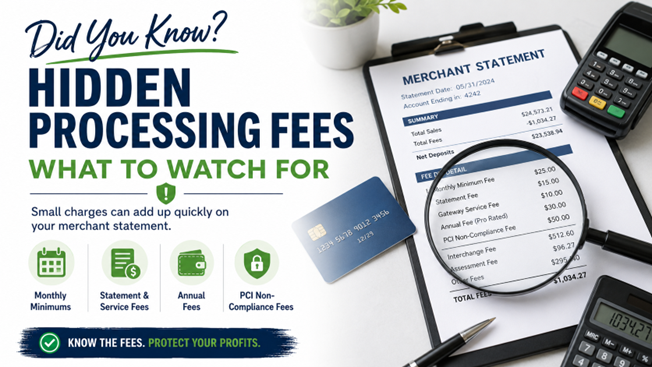
Did You Know A Monthly Minimum Fee May Show Up On Your Statement?
A monthly minimum fee is designed to make sure the processor earns a certain amount each month.
For example, if your business has a slower month and your regular processing fees do not meet that minimum amount, you may be charged the difference.
This fee is not always bad, but it should be clearly explained. No business owner should be surprised by charges they did not understand or expect.
If you see a monthly minimum on your statement, it is worth asking:
- What is the minimum amount?
- How is it calculated?
- Does it still make sense for my business volume?
A slower month should not automatically leave you feeling confused about your processing costs.
Did You Know Statement And Service Fees Can Add Up?
Some processors charge a statement fee, a service fee, or both.
These fees may cover things like customer support, account maintenance, statement preparation, or delivery. The issue is not always the fee itself. The issue is whether the fee is clear, fair, and explained up front.
Small fees may not seem like much on their own, but over time, they can add up.
This is why transparency matters.
A good processing partner should be willing to walk through your statement with you, explain what each fee means, and help you understand whether your account is set up in a way that still makes sense for your business.
Did You Know Annual Fees Should Not Be A Surprise?
Annual fees are another item business owners may see on their merchant statement.
Some are small. Some are more noticeable. Either way, they should not come out of nowhere.
A trustworthy processor should communicate annual fees clearly so you have time to budget, ask questions, and understand what the fee is for.
If you are surprised by an annual fee, that may be a sign it is time to review your agreement and your statement more closely.
Did You Know IRS Reporting Fees May Be Related To 1099 K Reporting?
Some merchants may see reporting related fees connected to annual tax reporting requirements.
Form 1099 K is used to report payment card transactions and certain third party network payments. While the reporting requirement itself is real, the way a fee appears on a merchant statement can vary depending on the processor.
That is why it is important to ask questions.
If you see an IRS reporting fee, regulatory fee, or tax reporting fee on your statement, ask what it covers, when it is charged, and whether it is recurring.
You deserve to understand the charges connected to your account.
Did You Know Supply Programs Are Not Always Needed?
Supply programs can be helpful for some businesses.
If you go through a lot of receipt paper or need quick access to processing supplies, a supply program may make sense.
But for other businesses, especially those with lower volume or digital receipt options, a monthly supply program may become an unnecessary cost.
The key is choice.
You should know whether you are enrolled, what you are paying, and whether the program is actually useful for the way your business operates.
Did You Know PCI Non Compliance Fees Can Be Avoided?
PCI compliance is not optional if your business accepts credit cards.
PCI standards are designed to help protect cardholder data and reduce the risk of security issues. For many businesses, PCI compliance includes completing a questionnaire, following security practices, and making sure payment systems are being used safely.
The fee that usually catches merchants off guard is not always the PCI fee itself. It is the monthly non compliance fee that may be charged when the required steps are not completed.
That can become frustrating fast.
The best way to avoid this is to stay proactive. Complete your PCI requirements, ask for help when needed, and make sure you know your compliance status.
At TMC, we help merchants understand this process so they are not left trying to figure it out alone.
The Bottom Line
Did you know hidden processing fees can impact your bottom line?
Fees are not always the enemy. Confusion is.
When you understand what you are paying for, you are in a better position to make smart decisions, ask better questions, and protect your business from unnecessary costs.
Your merchant statement should not feel like a mystery.
And your processor should not make you feel like you are on your own.
At TMC, we believe business owners deserve clear answers, honest support, and a partner who is willing to take the time to explain the details.
Because when you understand your processing, you can focus less on confusion and more on growing your business.
Review your Rates
Use our rate calculator to figure out what your effective rate is. Credit card processing fees can impact a business’s bottom line. By reducing these fees, businesses can improve their profitability. Contact our team for a FREE statement review. We typically see a savings of 25% or more!
Rate Calculator

Subscribe To OurBlog
Join our mailing list to receive the latest news and updates from our team.